
The Ruby-throated Hummingbird: A Winged Jewel of Our Summers
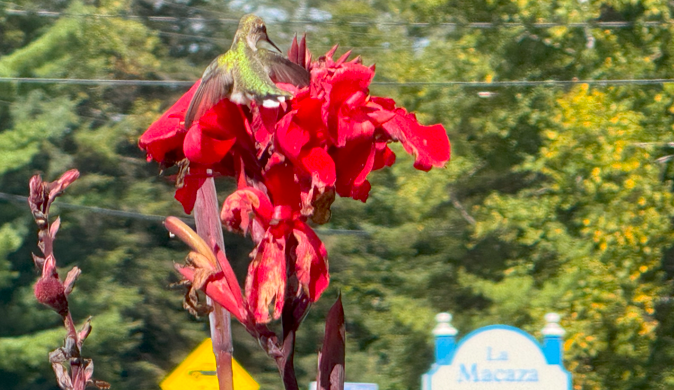
If you're fortunate enough to stay at Le Refuge des Eaux Vives between May and September, you may have the privilege of observing one of North America's most fascinating birds: the ruby-throated hummingbird. This tiny aerial acrobat, the only hummingbird species that regularly nests in Quebec, is a true miracle of nature whose presence enriches our local ecosystem.
Identifying the Ruby-throated Hummingbird
The ruby-throated hummingbird (Archilochus colubris) is a miniature bird weighing only 3 to 4 grams – barely heavier than a coin! Males are spectacular with their iridescent ruby-red throat that shimmers in the sunlight, metallic green back, and grayish-white belly. Females, slightly larger, display more subdued coloring: green back, white throat, and buff-tinted flanks.
What immediately distinguishes hummingbirds is their unique flight: they can beat their wings up to 53 times per second, producing the characteristic humming sound that earned them their name. They're the only birds capable of hovering, flying backward, and even upside down!
An Epic Migration
The ruby-throated hummingbird's story is one of extraordinary migratory achievement. These tiny travelers spend winter in Central America (Mexico, Costa Rica, Panama) and undertake each spring a journey of over 3,000 kilometers to return and nest in Quebec. Even more impressive: many cross the Gulf of Mexico non-stop – 800 kilometers of uninterrupted flight over water!
They arrive in the Mont-Tremblant region usually around mid-May, when the first flowers bloom, and depart in September before the first frosts. Males generally arrive a few days before females to establish their territory.
Extraordinary Metabolism
The hummingbird possesses the fastest metabolism of all warm-blooded animals. Here are some fascinating facts:
- Their heart beats between 250 and 1,200 times per minute (depending on activity)
- They must consume up to half their body weight in nectar each day
- They visit between 1,000 and 2,000 flowers daily
- At night, they enter torpor (a state close to hibernation) to conserve energy, lowering their body temperature from 40°C to 18°C
- They can reach speeds of 80 km/h in a dive
An Essential Pollinator
The ruby-throated hummingbird plays a crucial ecological role as a pollinator. With its long, thin beak and extensible forked tongue, it feeds primarily on the nectar of tubular red, orange, or pink flowers it particularly favors. By visiting flowers, it inadvertently transports pollen from one plant to another, ensuring their reproduction.
Its favorite flowers include:
- Bee balm (bergamot)
- Columbine
- Honeysuckle
- Phlox
- Salvia
- Cardinal flower
- Impatiens
Hummingbirds supplement their diet by capturing tiny insects and spiders, an essential source of protein, especially during nesting season.
Observing Hummingbirds at the Refuge
Here's how to maximize your chances of observing these winged jewels during your stay:
Best times: Hummingbirds are most active early morning and late afternoon. They regularly visit the same flower circuits throughout the day.
Where to look: Near flower beds, in gardens, around flowering shrubs, and sometimes even on the chalet terrace if there are potted plants.
Territorial behavior: Males are very territorial and vigorously chase any intruders from their feeding zone. You might witness spectacular aerial chases!
Signs of presence: Listen for their characteristic humming and high-pitched "chip-chip" calls. You'll often see them perched on an exposed branch, surveying their territory.
Attracting Hummingbirds (if you have a feeder)
If you wish to set up a hummingbird feeder, here are some tips:
Homemade nectar recipe:
- 1 part white granulated sugar
- 4 parts water
- Boil water, dissolve sugar, let cool completely
- NEVER add red dye (toxic to birds)
- Never use honey (promotes mold) or artificial sweeteners
Essential maintenance:
- Change nectar every 3-4 days (more often in hot weather)
- Clean feeder with hot soapy water each time
- Place feeder in partial shade to prevent fermentation
- Hang at least 1.5 meters above ground, away from windows
Strategic placement:
- Near natural flowers to create an attractive feeding zone
- Close to trees or shrubs where hummingbirds can perch
- In an open spot where you can easily observe them
Conservation and Protection
Although the ruby-throated hummingbird isn't a threatened species, its population depends on preserving its nesting habitats in Quebec and wintering sites in Central America. Here's how to contribute to its protection:
- Plant native nectar-rich flowers
- Avoid using pesticides that kill insects they feed on
- Maintain a diverse garden with staggered blooms from May to September
- If you have cats, keep them indoors during hummingbird season
- Preserve natural areas and vegetation corridors
An Unforgettable Spectacle
Observing a ruby-throated hummingbird is always a magical moment. Seeing this tiny living jewel perform its aerial acrobatics, hearing the hum of its invisible wings, and admiring the ruby reflection of its throat in the sunlight are experiences that mark you forever. These birds remind us of the fragility and extraordinary beauty of the nature surrounding us.
The presence of hummingbirds at Le Refuge des Eaux Vives testifies to the floral richness and quality of our natural environment. It's a privilege to share our space with these intercontinental travelers who choose our gardens as their summer stopover.
So, during your next stay, take time to settle quietly in the garden with a cup of coffee. Be patient, stay silent, and you might have the chance to witness the aerial ballet of a ruby-throated hummingbird – a spectacle you'll never forget!