
The Garter Snake: A Valuable Ally of Our Ecosystem
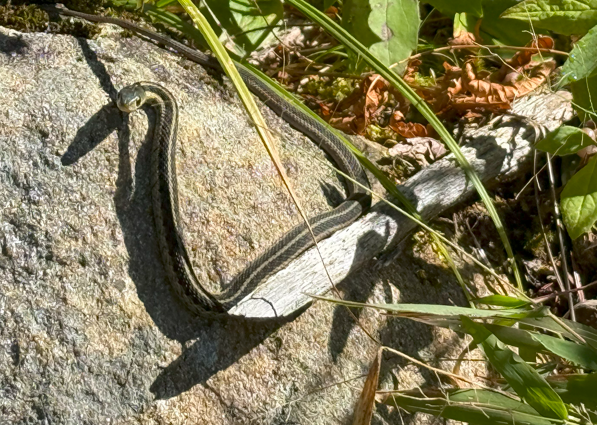
During your walks around Le Refuge des Eaux Vives, you might encounter a discreet and fascinating resident: the common garter snake. Far from being a cause for concern, spotting this small harmless snake is actually excellent news for the local ecosystem!
Identifying the Garter Snake
The garter snake is easily recognizable by its three longitudinal yellow or cream stripes running along its dark body (brown, greenish, or black). Typically measuring between 40 and 65 cm in length, sometimes up to one meter, it's one of the most common snakes in Quebec. Its slender body and smooth scales make it quite harmless to humans.
Unlike venomous snakes, the garter snake poses no danger. If frightened, it may release a musky odor or try to flee, but it never attacks. It's a shy animal that prefers to avoid encounters with humans.
A Precious Environmental Health Indicator
Seeing a garter snake around the Refuge is a very positive sign for several reasons:
Water Quality: Garter snakes live near water sources and feed on amphibians (frogs, salamanders) that are themselves extremely sensitive to pollution. Their presence indicates that the Rouge River and surrounding wetlands are healthy and free from toxic contaminants.
Biodiversity: As a predator of small prey (insects, slugs, worms, tadpoles, small rodents), the garter snake plays a crucial role in the food chain. Its presence demonstrates a rich and balanced ecosystem where each species finds its place.
Natural Habitat Preservation: Garter snakes need diverse habitats: sunny areas for thermoregulation, vegetation for shelter, water sources nearby. Spotting them confirms that the natural environment around the Refuge has been well preserved and not overly altered by human activity.
Absence of Harmful Pesticides: These reptiles are extremely sensitive to chemical products. Their survival in our territory proves that the environment is healthy and not contaminated by pesticides or other pollutants.
Behavior and Lifestyle
Garter snakes are diurnal and particularly active from May to September. You might spot them basking on rocks or along trails in the morning sun to warm their cold-blooded bodies. They're excellent swimmers and don't hesitate to dive into water to hunt or escape.
In winter, they hibernate in underground burrows, sometimes in groups, to protect themselves from the cold. They emerge in spring, a period when males actively search for females for reproduction.
Coexisting Peacefully
If you encounter a garter snake during your stay:
- Observe it from a distance without trying to touch or capture it.
- Don't kill it: remember it's a protected species and a valuable ally of the ecosystem.
- Let it go on its way: it will naturally flee your presence.
- Explain to children that it's a harmless and beneficial animal, not something to fear.
- Be mindful while gardening or moving objects: check underneath to avoid accidentally disturbing a resting snake.
Ecological Importance
By regulating populations of insects, slugs, and small rodents, the garter snake contributes to the natural balance of the Refuge. It's also prey for birds of prey, herons, and some mammals, thus integrating into a complex and essential food web.
Spotting a garter snake is therefore a privilege and proof that the nature surrounding Le Refuge des Eaux Vives is thriving. It's one of many reasons that make this place so special and authentic. So keep your eyes open during your walks – this discreet encounter could become a memorable highlight of your stay!