
Following Deer Tracks: Learning to Read the Forest
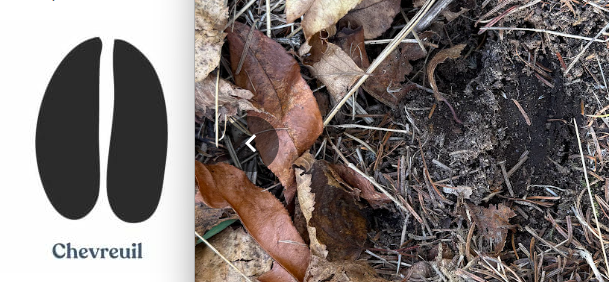
During a recent walk on the grounds of Le Refuge des Eaux Vives, we made a discovery that reminded us how alive and present nature is around us: beautiful deer tracks, perfectly imprinted in the soil. These fresh, well-defined prints bear witness to the nocturnal or early morning passage of these graceful forest inhabitants.
This finding is the perfect opportunity to invite you to a practice as ancient as it is fascinating: the art of reading the tracks and signs left by wildlife.
Recognizing Deer Tracks
White-tailed deer tracks are easily recognizable by their characteristic shape. Like all cervids, deer have cloven hooves that leave a distinctive mark in the form of two elongated half-moons, pointing forward.
Track Characteristics:
- Shape: Two toes (hooves) forming a heart or inverted horseshoe, with a slit in the middle
- Size: About 5 to 8 cm in length for an adult
- Particulars: The two toes are symmetrical and point forward. In some cases, especially if the animal is running or walking in soft ground, you can also see the dewclaws (small vestigial digits located at the back of the hoof) that leave two small marks behind the main toes.
Difference from Other Animals:
- Larger and more elongated than dog tracks
- Smaller than moose tracks (which can reach 15 cm)
- The toes are noticeably more pointed than those of domestic cattle
The Walking Pattern: A Unique Signature
Beyond the individual print, observing the walking pattern (the arrangement of successive tracks) reveals much about the animal's behavior:
Normal Walk: Tracks form a relatively straight line, with regular spacing of about 40 to 60 cm between each print. Deer often place their hind foot almost exactly in the print of their front foot, giving the impression of only a single track.
Trot or Flight: Tracks space out more, and all four hooves leave distinct marks. Spacing can reach 1 to 2 meters between each group of prints.
Bounds: In rapid flight, deer bound and their four feet land grouped together, leaving a set of four close prints, spaced 2 to 4 meters from the next group.
What Do These Tracks Reveal?
The tracks found on the Refuge grounds tell us a story. By observing carefully:
- Freshness of Prints: Sharp edges and clean bottom indicate recent passage (probably early morning or during the previous night)
- Direction: Tracks show the animal was heading toward the river, probably to drink
- Gait: Regular spacing suggests a calm walk, with no sign of stress
- Size: Dimensions indicate probably an adult individual
These clues confirm what we already knew: deer regularly visit the grounds, taking advantage of water access and abundant vegetation, while maintaining a respectful distance from dwellings.
Other Signs of Deer Presence
Tracks are just one of many signs that deer leave in their environment. By keeping your eyes open, you might also observe:
Droppings (Scat): Small oval pellets, black and shiny, measuring about 1 to 2 cm. In winter, they're often in small clusters. In summer, when diet is richer in water, they can be softer and grouped.
Browsed Branches: Deer, having no front teeth on their upper jaw, tear off twigs and leaves, leaving an irregular, jagged break (unlike a clean cut made by tools).
Rubs: In fall, males rub their antlers against young trees to mark their territory and remove the velvet covering their antlers. These rubs leave torn bark and broken branches at chest height.
Scrapes: Circular areas 30 to 60 cm in diameter where the ground has been scraped down to bare earth, often under low branches. These are olfactory communication sites where males urinate and leave their scent during the rut period.
Trails: Well-worn paths in vegetation, connecting rest areas to feeding zones and water points. Deer regularly use the same paths, creating these visible passages.
The Invitation: Observe Everywhere, Always
This discovery of deer tracks reminds us of an essential truth: nature is an open book for those who take time to read it. Each forest walk, each moment spent outdoors is an opportunity for learning and wonder.
We therefore invite you, during your stay at the Refuge, to adopt the tracker's attitude:
Look at the Ground: That's where you'll find tracks, of course, but also many other clues. Scraped soil, turned leaves, broken branches, mushrooms, small flowers... The ground tells a thousand stories.
Observe the Trees: Torn bark, broken branches at different heights, woodpecker holes, lichens, mosses... Trees bear the marks of all the life surrounding them.
Scrutinize the Vegetation: Flattened grass, spider webs, browsed plants, presence of berries... Every detail matters.
Listen: Alarmed birds, rustling in leaves, a blue jay's cry signaling a predator... The forest also speaks with sounds.
Smell: A fox's musky odor, resinous scent of conifers, humidity announcing a watercourse... Our senses are observation tools.
Take Your Time: Observation isn't done while walking quickly. Stop often, sit down, let your senses absorb the environment. It's in calm and patience that nature reveals itself.
Becoming a Nature Reader
Learning to identify wildlife tracks and signs is a skill accessible to all, which greatly enriches the nature experience. It's like learning a new language: at first, you only recognize a few words, but gradually, entire sentences reveal themselves, then complete stories.
Here are some tips for progressing in this art:
Start Simple: First learn to recognize tracks of the region's most common animals (deer, hare, squirrel, raccoon).
Photograph: Take photos of tracks you find with an object for scale (your hand, a coin, a stick). You can identify them calmly later.
Consult Guides: Excellent field guides on animal tracks and signs exist. Bring one on your outings.
Compare: Observe tracks in different conditions (dry soil, mud, snow, sand) to understand how they vary.
Be Curious: Every unusual clue deserves attention. What created this mark? Why was this tree scraped here? Why are these droppings grouped in this spot?
Snow: The Best Time for Tracking
If you stay at the Refuge in winter, you'll have an exceptional opportunity to observe tracks. Fresh snow is like a blank page on which all wildlife movements are recorded with perfect clarity.
After a snowfall, go out early in the morning and you'll see all the nocturnal activity: deer comings and goings, hare bounds, fox tracks seeking mice, mouse tunnels under the snow, bird prints... It's a fascinating spectacle that reveals how active wildlife remains even in Quebec's winter cold.
Respect and Wonder
Observing these deer tracks on the Refuge grounds reminds us of a humbling truth: we share this space with countless other living beings who are at home here. These prints are the discreet signature of an animal that walked here, that drank from the river, that is an integral part of this ecosystem.
It's also a reminder of our responsibility: respect these natural spaces, minimize our impact, don't disturb wildlife, and preserve these habitats for future generations, both human and animal.
So, during your next stay at Le Refuge des Eaux Vives, we invite you to slow down, observe, and marvel. Look at the ground, scrutinize the trees, open your senses wide. The Laurentian forest is filled with fascinating stories written in mud, engraved in bark, drawn in snow.
Who knows what tracks you'll discover? Perhaps those of a deer, a lynx, a porcupine, or an otter? Each discovery will be a window into the secret and marvelous world of the wildlife surrounding us.
Nature speaks to those who know how to listen. You just have to take the time to observe.